
Why More Website Traffic Does Not Always Mean More Clients
Thursday, January 15, 2026
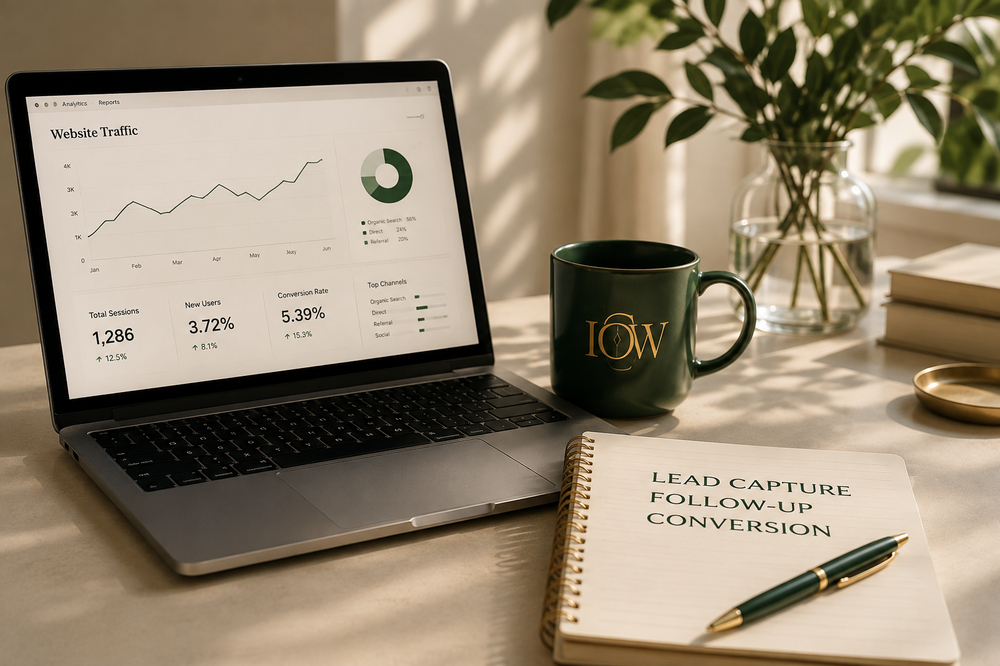
More traffic sounds like the obvious answer when growth feels slow.
More visitors should mean more enquiries. More enquiries should mean more clients.
But many service businesses increase their website traffic and see little meaningful change in revenue.
That is because traffic is not the outcome. It is the beginning of a customer journey.
If the journey after the click is unclear, high-friction or poorly followed up, more traffic simply creates more opportunities to lose potential clients.
Visibility is not conversion
SEO, social media, referrals, paid advertising and partnerships can all bring people to your website.
But attention is not the same as intent.
And intent is not the same as an enquiry.
When someone lands on your site, they are quietly deciding:
Is this business relevant to me?
Do I understand what they do within a few seconds?
Do I trust their approach?
Is the next step clear?
Does taking that next step feel easy?
Is there enough reason to act now rather than later?
If the answer becomes unclear at any point, they may leave.
Not necessarily because they were the wrong visitor.
Sometimes the website simply failed to give a genuinely interested person a clear path forward.
The real gap is often between interest and action
Most visitors are not ready to make a call the moment they arrive.
They may be researching options, comparing providers, discussing a decision internally or simply exploring what is available.
If the only conversion path is Contact Us, many interested people will disappear before they are ready to take that step.
A stronger website gives visitors an appropriate next action based on where they are in the decision process.
Visitor intent Useful next step
Ready to speak Book a consultation or submit an enquiry
Interested but comparing View a case study, process, service guide or pricing information
Curious but early-stage Download a relevant guide, checklist or assessment
Returning and considering Receive useful follow-up or enter a relevant nurture sequence
The goal is not to force every visitor into a sales conversation.
It is to capture genuine interest and help the right people move forward.
A website should create a clear path forward
A website needs to inform and build trust.
But information alone is not enough.
A visitor should be able to understand:
the problem you solve
who you solve it for
the outcome you help create
why your approach is credible
what they should do next
That usually means your most important pages need:
a clear, audience-specific headline
a simple explanation of the problem and desired outcome
proof through testimonials, outcomes, case studies, credentials or examples
one clear next step
a conversion path that works properly on mobile
a relevant option for people who are interested but not yet ready to enquire
When a page contains several competing actions, vague copy, hidden contact details or unnecessary form fields, it creates friction at exactly the moment a potential client is deciding whether to continue.
Clarity reduces that friction.
Lead capture is only one part of the system
An enquiry form is not a conversion system.
The moment someone submits their details, another part of the customer journey begins.
What happens next?
Do they receive an immediate acknowledgement?
Does the right person know the enquiry has arrived?
Is the lead recorded somewhere consistently?
Is there an agreed response time during business hours?
Is there a clear next action?
Are prospects who are not ready today followed up meaningfully?
Can the business see which leads progressed and which disappeared?
The important point is not that every lead needs an instant personal reply at all hours.
It is that each enquiry receives a clear acknowledgement, has an owner and moves into a consistent next step.
The longer a warm enquiry sits untouched, the more likely it is that attention fades, priorities shift, or the prospect speaks with another provider.
If leads sit in an inbox, are assigned inconsistently or receive no follow-up after the first interaction, the business may assume it has a traffic problem when the real issue sits further down the journey.
Find the leak before buying more traffic
Instead of looking at website traffic as one isolated number, map the entire path:
Traffic → Key Page → Lead → Qualified Conversation → Client
Then measure the conversion between each stage.
Useful metrics might include:
Visitor-to-lead rate: how many visitors become enquiries or captured leads
Lead-to-conversation rate: how many leads progress to a meaningful sales conversation
Conversation-to-client rate: how many qualified conversations become clients
Response time: how long it takes for a new enquiry to receive the agreed next action
Follow-up completion rate: how consistently the agreed follow-up process actually happens
This changes the question from:
How do we get more traffic?
to:
Where are we currently losing qualified opportunities?
That is usually a much more valuable question.
High traffic with very few leads may point to unclear messaging, weak offers, poor mobile experience or a difficult enquiry process.
Strong lead volume with very few conversations may indicate slow follow-up, poor qualification or a broken booking process.
Plenty of conversations with very few clients may mean the issue sits in positioning, pricing, sales process or the offer itself.
The traffic number alone cannot tell you that.
Consider a business receiving 2,000 website visitors each month and generating 40 leads.
If only 10 of those leads receive timely follow-up, the priority may not be generating more visitors — or even more leads.
The more useful question is why 30 potential conversations are not progressing.
More traffic cannot repair a broken journey
More traffic into a weak system does not automatically create more clients.
It creates more leakage.
The next stage of growth may not require another campaign, a larger advertising budget or another month of publishing content.
It may require:
clarifying what you do and who it is for
giving each key page one clear next step
capturing interest from people who are not yet ready to enquire
improving confirmation and follow-up
keeping lead information in one organised place
setting a consistent response process
measuring where opportunities are being lost before trying to scale
Sometimes the highest-leverage marketing decision is not generating more attention.
It is making the attention you already have more valuable
Build the journey, not just the traffic
Attention was never the end goal.
The goal is a connected journey that turns visibility into trust, trust into action, and the right enquiries into meaningful sales conversations.
That is when marketing begins to operate as a growth system rather than a collection of disconnected activities.
Want to see where your customer journey may be losing opportunities?
Download the free Lead-to-Wealth Checklist — a practical review of the path from website visibility and enquiry to follow-up, sales conversations and conversion.

About Intuitive Overflow Wealth
Where visibility, business systems, numbers and wealth psychology meet practical growth

Marketing, SEO and lead funnels for Australian mortgage brokers.
EXPLORE
CONNECT
Privacy Policy | Terms & Conditions
© 2026 Jadie Global Pty Ltd trading as Intuitive Overflow Wealth. ABN 54 656 153 927.