
Mortgage Broker Lead Generation: A Practical Guide for Australian Brokers
Sunday, November 01, 2026

A lead is not a result. A booked consultation is closer. A settlement is the result. Everything in between is plumbing - and most of the leaks happen where nobody is looking. This guide breaks down how Australian mortgage brokers can build a lead generation system that produces consistent leads, booked consultations and measurable returns, rather than relying on a tap that someone else controls.
Introduction: Why Lead Generation Matters for Mortgage Brokers in Australia
There are more than 24,000 mortgage and finance brokers in Australia — roughly one for every 904 adults, according to the MFAA. Brokers facilitated a record 81.6% of all new residential home loans in the June 2026 quarter. The market is mature and competitive, with online lenders, aggregator platforms and direct-to-consumer fintechs all chasing the same borrowers.
From a Chartered Accountant's perspective, lead generation is the top of the revenue funnel. Leads become consultations, consultations become lodged applications, applications become settlements, and settlements generate upfront commissions and trail income. Without a steady stream of enquiries feeding that funnel, cash flow becomes unpredictable and business valuation suffers. Establishing trust and delivering value are critical for converting mortgage leads into settled clients.
Using diverse digital channels can amplify lead generation effectiveness for mortgage brokers. But there are two fundamentally different paths: buying leads from a provider, or building a system you own and control. One costs money every month with no residual asset. The other compounds over time.
Here are the building blocks this article covers:
- Buying leads vs owning your system
- Lead generation in numbers (cost per lead through to cost per settlement)
- Building a lead funnel that works in Australia
- Local SEO, Google Business Profile and Google reviews
- Content marketing and lead magnets
- Speed to lead, automated workflows and booking tools
- Referral partners and referral funnels
- Tracking which channels actually produce settlements
- Staying compliant while marketing your business
Buying Leads vs Owning Your Mortgage Lead System
Pay-per-lead providers generate enquiries through shared forms, paid advertising or telemarketing, then sell those enquiries to brokers. Exclusive mortgage leads from Australian providers are commonly priced anywhere from around $100 to $300+ per lead, depending on quality and exclusivity.
But here is the trade-off:
- Lead quality and intent: Bought leads are often lower intent - cold comparison shoppers, sometimes shared with other brokers. With your own system, leads are higher intent - people who found you via Google search, content or referral.
- Control over volume, cost and brand: When buying, you pay what the provider charges and the ad copy and landing pages are theirs. When you own the system, you set the budget, build the landing pages and own the brand experience.
- Compliance risk: Provider scripts and pages may not meet Australian credit advertising rules. Owning your system gives you full oversight of every touchpoint.
- Asset value: Bought leads stop the moment you stop paying. SEO, content, reviews and referral networks compound over time.
A hybrid approach combining purchased leads with inbound strategies is most effective for mortgage brokers - especially when starting out. Using targeted paid search ads captures immediate leads while owned channels build momentum. But the priority should be building channels that generate leads on their own.
Consider an illustrative example: a broker buying 40 leads a month at $180 each spends $7,200. If 10% settle, that is four settlements — and the pipeline stops the day the spending stops. Money invested in local SEO, content and referral systems works differently: results build more slowly, but the pages, reviews and relationships keep producing enquiries long after the work is done.
Lead Generation in Numbers: From Cost per Lead to Cost per Settlement
Every mortgage professional should know their numbers. Not just how many enquiries came in, but how many of those became booked consultations, lodged applications and settled loans. Defining clear KPIs underpins every digital marketing strategy, and performance marketing ensures each dollar delivers accountable results.
Track these metrics across all lead generation efforts:
- Number of enquiries (leads)
- Number of booked consultations
- Number of lodged applications
- Number of settled loans
- Marketing spend by channel
Illustrative worked example (numbers are hypothetical, not a guarantee):
A Sydney mortgage broker spends $2,000 in one month across Google Ads and social media marketing. That spend produces 40 leads. Of those, 16 book consultations (40% appointment rate). From 16, eight lodge applications (50%). Five proceed to settlement (62.5% from application; 12.5% from initial enquiry).
- Cost per lead = $2,000 ÷ 40 = $50
- Cost per booked appointment = $2,000 ÷ 16 = $125
- Cost per settlement = $2,000 ÷ 5 = $400
If average net revenue per settlement is $2,500, then paying $400 to acquire it is profitable. If the channel's conversion rates are weak, margins shrink fast. Tracking metrics on lead conversion and engagement is crucial for marketing efficiency. The formulas are simple:
- Cost per lead = Total marketing spend ÷ Number of leads
- Cost per appointment = Total marketing spend ÷ Number of booked consultations
- Cost per settlement = Total marketing spend ÷ Number of settled loans
Use these numbers to decide whether to double down on a channel, fix the conversion in the middle of the funnel, or cut it entirely.
Building a Mortgage Broker Lead Funnel That Works in Australia
A sales funnel for mortgage professionals maps the journey from stranger to settled client to referrer. A well-optimised website is crucial for attracting clients at every stage. Precise qualification of leads can enhance overall business efficiency in mortgage brokerage, so the goal is not just more leads - it is the right audience, matched to the segments you serve best.
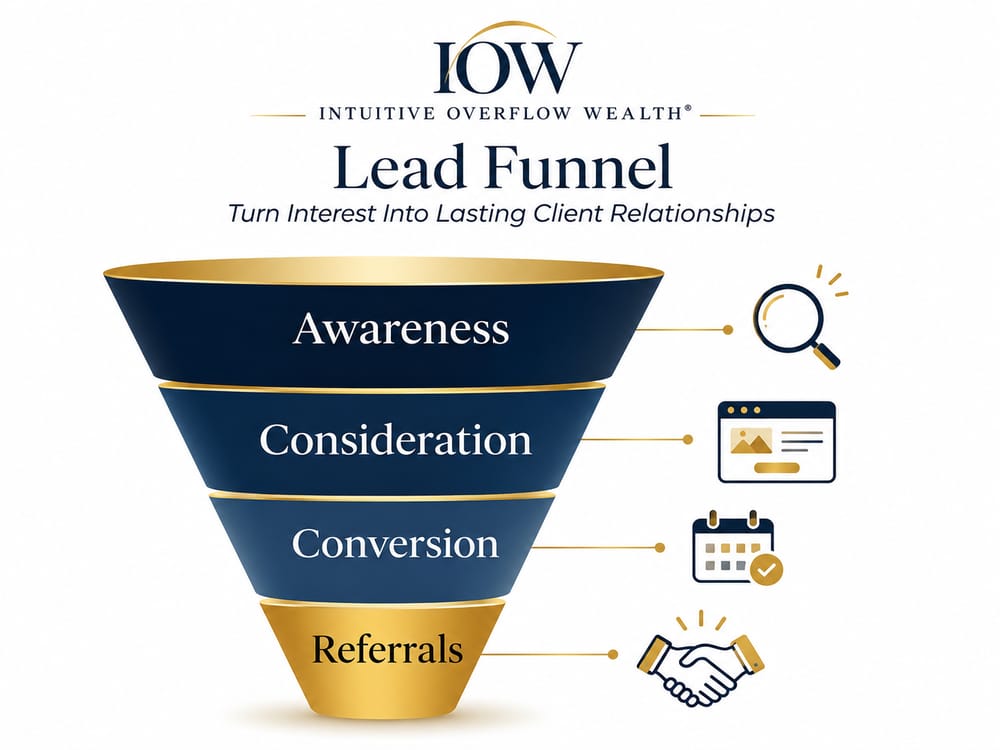
The stages:
- Awareness: Local SEO, Google Business Profile, social media platforms, content marketing, networking events and community visibility get you in front of potential clients.
- Consideration: Landing pages tailored to first-home buyers, investors, refinancers or self-employed borrowers. Lead magnets. Short explainer videos. High-intent leads are those actively searching for mortgage services at this stage.
- Conversion: Enquiry forms, booking tools and speed-to-lead follow-up turn interest into a booked consultation.
- Loyalty and referrals: Email nurture, review generation and referral funnels turn satisfied clients into repeat business and introductions.
Intuitive Overflow Wealth's Flow System connects these stages: funnels, automated workflows, appointment booking and referral marketing - so no enquiry falls through the gaps.
Local SEO, Google Business Profile and Google Reviews for Mortgage Brokers
Most borrowers search locally for a mortgage broker. Searches like "mortgage broker near me" show that borrowers look for help close to home. Local SEO practices are crucial for mortgage brokers to capture nearby clients, because if you do not appear in Google Maps and the local search results, you are invisible to borrowers who are ready to act.
Core local SEO actions:
- Claim and optimise your Google Business Profile: correct categories, description, services, service areas, hours, phone, website, high quality photos and regular posts.
- Build location-specific landing pages on your website targeting suburbs and service areas (e.g. "Home loans in North Sydney"). Location-specific landing pages improve visibility for local clients. Local SEO targets city-specific keywords like "mortgage broker in Parramatta".
- Technical SEO: mobile optimisation improves user experience and engagement rates. SEO strategies should target local keywords to attract potential borrowers, and SEO helps websites rank higher in search results.
Google reviews act as both an SEO signal and social proof. Soliciting reviews enhances credibility and local SEO rankings. A compliant way to ask: "If you were happy with my service, would you mind leaving a review so others in your area can find a broker they trust?" Never promise outcomes or use misleading language in review requests.
Use automated workflows after settlement to request a Google review via email or SMS, then track responses inside your CRM.
What a strong Google Business Profile should show at a glance:
- High quality photos of your office and team
- 4.8+ star rating with positive reviews
- Several recent reviews, not just old ones
- Clear call to action ("Book a consultation" or "Call us")
- Accurate service areas and business hours
- Services listed with descriptions
Monitor organic visibility using Google Search Console (impressions, clicks, position) and Google Analytics (traffic sources, conversion rates). Refine keywords and pages where you rank but are not converting.
Content Marketing That Attracts and Educates High-Intent Borrowers
Content marketing is a long-term way to generate consistent leads by answering the exact questions borrowers type into Google search. Regularly publishing keyword-rich content boosts organic visibility and lead generation. Educational content builds long-term authority in the finance sector, and content marketing positions brokers as trusted authorities in the mortgage industry.
Concrete content types for Australian lending specialists:
- Suburb-specific borrowing guides: "Buying your first home in Newcastle in 2026" captures local searchers and builds your client base in that local area.
- Checklists as lead magnets: A "First Home Buyer Document Checklist" exchanged for contact details brings in qualified leads.
- Short AI-assisted explainer videos: Cover fixed vs variable rates, offset accounts or refinancing timelines for social media. Visual content performs well on social media platforms and your Facebook page.
- Case studies: Anonymised client journeys showing how you solved a problem - without promising specific rates or approvals.
- Interactive tools: Interactive tools like mortgage calculators capture leads effectively and engage potential clients in the decision making process.
Answering real client questions positions you as a trusted advisor rather than just another broker.
Conducting educational seminars - whether in-person at networking events or as webinars - can attract potential mortgage clients and deepen your target market relationships.
Use Google Search Console to find queries that already bring impressions but low clicks, then create or upgrade pages to better match search intent. Plan content creation with a simple calendar: weekly blog post, fortnightly video, monthly long-form guide. Compelling content published on a rhythm outperforms ad-hoc efforts every time. Many brokers leave this to chance. Cotality's State of Content Marketing 2026 research, based on a Broker Pulse survey of 414 Australian brokers, found only 19% communicate consistently with clients or referral partners, while 45% don't communicate regularly at all. Those who do report measurable outcomes: more enquiries, stronger referrals and better retention.
Lead Magnets, Landing Pages and Booking Tools
A lead magnet is something valuable enough that a prospect is happy to share their email and phone number. It must be relevant to your ideal client and compliant - no promises of approval or specific rates.
Lead magnet ideas for mortgage brokers:
- Downloadable PDF: "7 Steps to a Smoother Home Loan Application in 2026 - Without the Headache" (educational, general guidance, clearly labelled as general information only).
- Simple borrowing power guide with rough income-to-borrowing ranges and clear disclaimers.
- Investor worksheet for tracking existing debts, rental yields and cash flow across properties.
Landing page essentials:
- One main call to action - do not dilute with competing links
- Short copy, bullet list of benefits, simple form (name, email, mobile, postcode, scenario checkbox)
- Trust signals: Google review rating, professional accreditations, general disclaimer
After form submission, present a booking tool (Calendly-style) so prospects can book a 15–30 minute discovery call immediately. This removes friction and significantly lifts conversion rates from visitor to booked consultation.

Speed to Lead, Automated Workflows and Email Nurture Sequences
Responding within minutes rather than days makes a real difference to whether an enquiry becomes a booked meeting. Most brokers lose enquiries not because they lack leads, but because follow-up is too slow. Automated follow-up systems increase the likelihood of converting leads into consultations. Automated workflows can streamline lead nurturing processes across the entire mortgage process.
Set up automated workflows so that:
- New enquiries receive an instant, personalised confirmation email (and optional SMS) with clear next steps and a link to your booking tool.
- Hot leads (those who tick "ready to apply now") are flagged for immediate phone follow-up.
- Colder or early-stage leads enter a lead nurturing email sequence, segmented by type (first-home buyer, investor, refinancer, self-employed).
Basic email nurture sequence (first 14–21 days):
- Email 1 (immediate): Thank you, quick intro, link to book a consultation.
- Email 2 (day 3): Short story-based case study relevant to their scenario - valuable content that builds trust.
- Email 3 (day 7): Educational content, e.g. "What banks really look for in 2026" with compliance-friendly wording. Email campaigns can provide personalised, valuable content to leads.
- Email 4 (day 14): Reminder to book a chat, plus soft prompt to reply with questions. Regular communication with leads builds trust over time.
Building a database for ongoing communication can optimise client retention and referrals long after settlement. Automated email campaigns can enhance client reactivation strategies - prompting past clients to consider refinancing or referring friends when the time is right.
Automation should feel human. Use the prospect's name, suburb and loan purpose. Avoid spammy language. Intuitive Overflow Wealth designs and connects these automated workflows as part of the Flow System for busy brokers who want to focus on consultations, not manual follow-up.
Referral Partners and Referral Funnels: Real Estate Agents, Accountants and Planners
Referral partners often produce the highest-converting mortgage leads because trust is already built before the introduction. According to MFAA data, referrals account for roughly 28% of new business, while repeat clients make up about 44%. Client referrals can form a key part of lead generation strategies for brokers. Referral partnerships with real estate agents and accountants drive high conversion rates.

Key partner types:
- Real estate agents and buyer's agents
- Accountants and tax advisers (especially for investors and self-employed borrowers)
- Financial planners and wealth advisers
Make partnerships structured, not hope-based:
- Define your ideal client profile so partners refer new clients you serve well.
- Set expectations on communication, response times and how you will look after their clients.
- Share regular, high-level updates on referrals without breaching privacy.
Build a referral funnel:
- Dedicated partner landing page with co-branded messaging
- Unique contact form or link for each partner so you can track the source
- Automated thank-you and status updates for the partner
Integrate referral tracking into your CRM. Tag every settlement to a specific partner so you can calculate conversion rate and revenue generated per partner. Generating high-quality leads relies on trust-building and strategic partnerships - and that means measuring which partnerships deliver more business and which need attention.
Compliance reminder: Disclose any referral fees or commissions as your credit licence obligations require, and check arrangements with your aggregator or licensee. For advertising, follow ASIC's Regulatory Guide 234.
Tracking, Analytics and Knowing Which Channels Actually Produce Settlements
What gets measured gets managed. New brokers and experienced operators alike need to know which channels bring not just clicks, but actual settled clients.
Simple tracking framework:
- Use UTM tags on all digital marketing links so Google Analytics can attribute traffic and conversions by campaign.
- Configure goals in Google Analytics for key events: lead form submissions and completed bookings.
- Use Google Search Console to monitor search queries, click-through rates and positions for key service pages.
Connect web analytics with your CRM:
- Every new lead gets a "source" and "campaign" field.
- CRM platforms should produce reports showing leads, appointments, applications and settlements by source - SEO, Google Ads, social media, email, referral partners, offline events.
- Google Ads can target high-intent keywords effectively, but you need to track whether those clicks become settlements, not just leads.
Regular reporting highlights pipeline stages with leakage or underperformance. Use this data to make decisions: pause underperforming campaigns, increase budget on high-ROI channels, and adjust ad copy or messaging where click-through is high but conversion is low. Making adjustments based on real data separates effective lead generation from guesswork.
Monthly review rhythm: Block 60–90 minutes to scan dashboards, identify trends, check website's performance, and set one optimisation action per channel. Continuous optimisation, not one-off campaigns, drives long term success.
Staying Compliant While Marketing Your Mortgage Business
All lead generation efforts, digital marketing and automated messages must comply with Australian credit advertising and privacy rules. This is non-negotiable.
Practical compliance checks:
- Never promise loan approvals or specific interest rates in ads, content or landing pages.
- Include clear disclaimers that information is general in nature and not personal credit advice.
- Handle personal data collected via forms transparently, in line with privacy obligations.
- Review and approve email templates, landing pages, social media posts and ad copy before they go live.
- Audit automated workflows at least annually - or when regulations change - to ensure all touchpoints remain compliant.
Effective lead generation strategies can be built well within the rules. Compliance is a design constraint, not a barrier. The brokers who attract clients with honest, relevant content and clear processes earn deeper trust - and that trust turns into new clients, referrals and a stronger client base over time.
Next Steps: Building a Sustainable Lead Generation System with Intuitive Overflow Wealth
The most valuable asset a mortgage broker can build is a repeatable, measurable lead generation system that turns strangers into settled clients and active referrers. Traditional methods alone will not keep pace. Effective strategies combine local SEO, Google Business Profile and Google reviews, lead magnets, content marketing and digital funnels, speed to lead, automated workflows and booking tools, referral partners and referral tracking, and analytics-driven decision making.
Sustainable growth comes from connecting these pieces into one system - not from running harder on a treadmill of paid ads and bought leads. Intuitive Overflow Wealth is the specialised partner for Australian brokers who want to connect these components into one Flow System, without becoming full-time marketers or tech experts. Founded by a Chartered Accountant, we understand broker numbers, cash flow and growth - not just marketing.
Book a free strategy call. We will review your current lead generation, run through your numbers, map the gaps in your client journey and give you practical next steps. No obligation, no jargon - just a clear plan to generate more leads that actually settle.

About Intuitive Overflow Wealth
Where visibility, business systems, numbers and wealth psychology meet practical growth

Marketing, SEO and lead funnels for Australian mortgage brokers.
EXPLORE
CONNECT
Privacy Policy | Terms & Conditions
© 2026 Jadie Global Pty Ltd trading as Intuitive Overflow Wealth. ABN 54 656 153 927.